
Nir Spectroscopy
NIRS is a method of testing that utilises certain physical properties of the material, specifically their interaction with near infrared radiation…
> Other techniques


Nir Spectroscopy
The time required for a single test ranges from a few seconds to a few minutes.
This method allows for rapid testing of numerous samples with a notable reduction in time and cost compared to traditional techniques. This is possible largely thanks to the simplicity of the preparatory stages and the variety of possible tests. The ability to reuse the sample and the lack of use of reagents complete the image for the advantages of this technology.
The Laboratorio Analisi Zootecniche has created calibration/reading curves using the standard chemical testing laboratory and has identified the ideal means of preparing samples, especially for unifeed and silage; the calibration curves are periodically updated depending on agronomic variables [the calibrations are developed using WIN-ISI and UCAL (Unity Scientific) software to guarantee maximum accuracy and robustness].
The spectral range is from 1100 to 2498nm. To add to the service of rationing parameters, the laboratory has begun a collaboration with Dairyland (USA) for the digestibility of NDF and starch (see “remote NIRS technique”).
A few examples of sample preparation:
| PRIMARY PHASE | SECONDARY PHASE | THIRD PHASE | FOURTH PHASE | |
|---|---|---|---|---|
| Unifeed | Grinding with blade cutter 40L | Drying in stove 16 hours | Grinding in mill 0.5mm | NIR scanning of dry ground products |
| Silage/corn silage | Grinding with blade cutter 40L | Essicazione in stufa 16 ore | / | NIR scanning of unaltered ground products |
| Hay | Grinding with blade cutter 40L | / | Grinding in mill 0.5mm | NIR scanning of ground products |
Alongside this, the laboratory makes use of the highest level of Italian university supervision/consultancy in the field of NIR.
The table below lists the parameters analysed for each food matrix
The method is not applicable to a complete test of all elements, such as, for example, minerals.
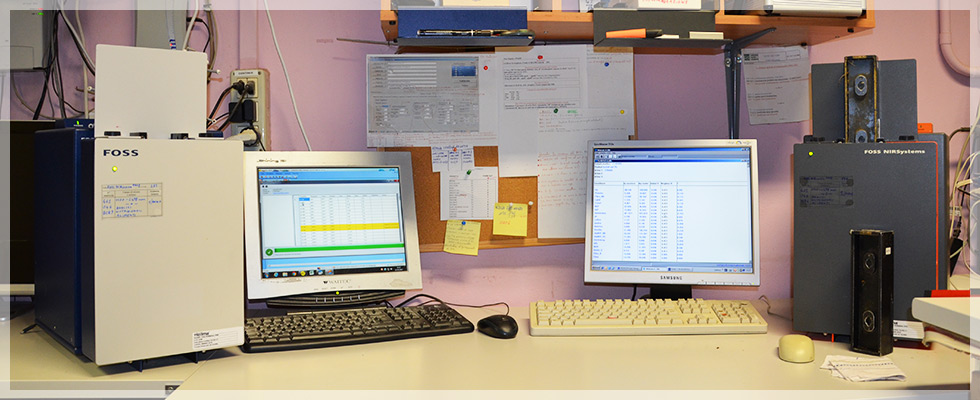
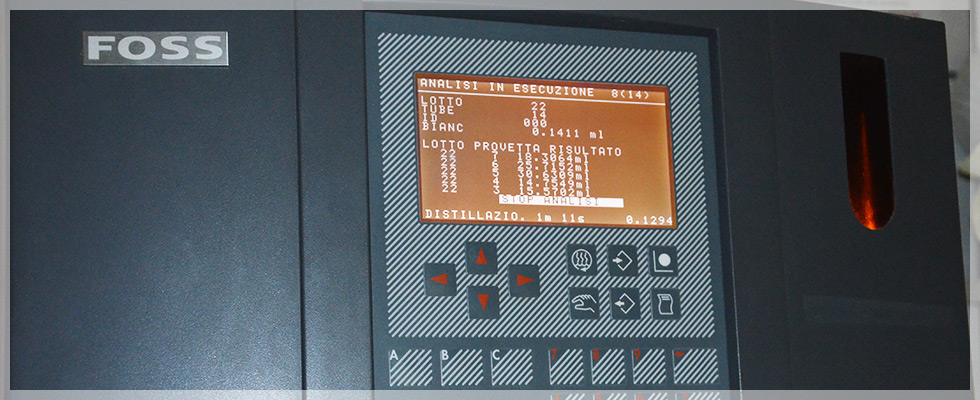
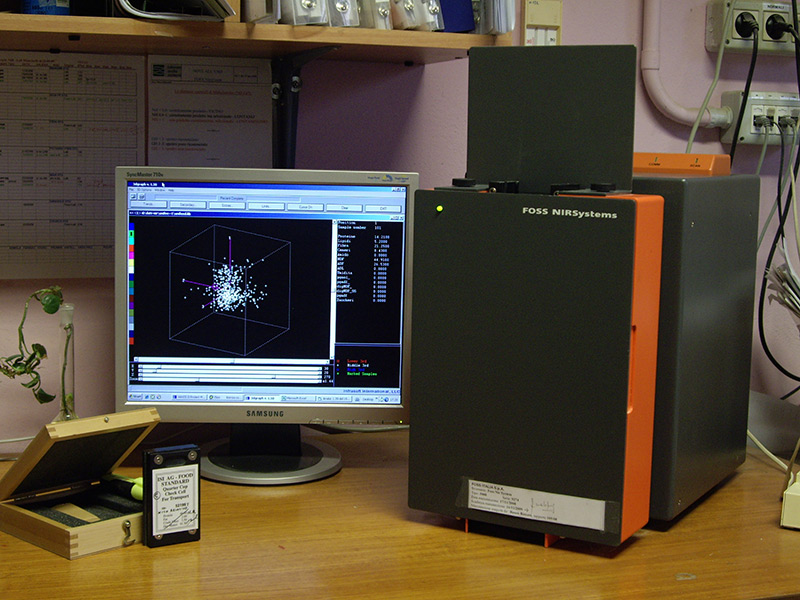
NIR images
See a range of examples of tests carried out using the NIR spectroscopy method…
Parameters analysed by NIR
Parameters calculated on some products are provided: NFC; N-amm./N-tot; RFV Note1= Corn Ear excluded
(*) = Feed: Bovine / Pigs;
(*) = S. R. M. (Starchy Raw Materials and by-products):
Corn grain – Distillers – Wheat – Barley – Bran.
(**) = P. R. M. (Protein Raw Materials and by-products):
Rapeseed E.F. and cake – Sunflower E.F. – Soy E.F. – Whole soy and cake.
“E.F.” = extraction flour


Remote NIRS technique: NDFD, uNDF and IVSD
The most important parameters are the digestibility of the NDF (NDFDD) and the undigested NDF (uNDF) in forage crops, as well as the digestibility of the starch (IVSD, 7h: In Vitro Starch Digestion at 7 hours) in corn as indicated in the “NIR parameters” table.